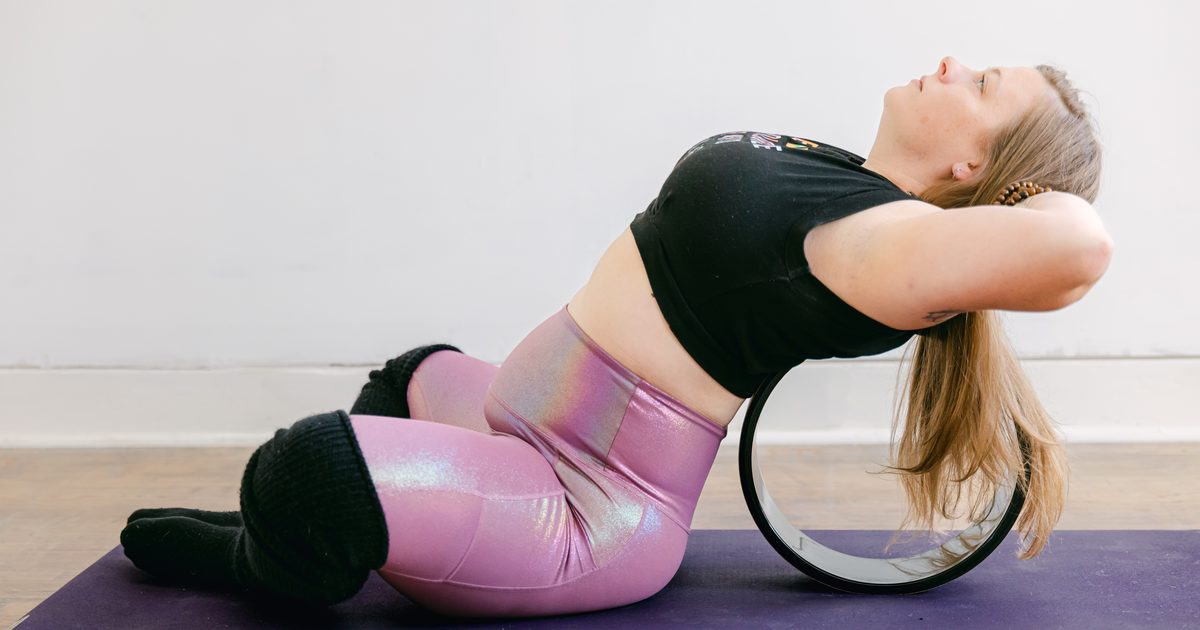
Tonight is Samhain, the old Celtic new year. It marks the turn into the dark half of the year, and it was said to be the night the veil between worlds runs thin. In class this week we sat with that idea: the dark half, the shadow side, the parts of ourselves we would rather not look at.
Somewhere in the middle of that class it got very literal. Because your body has a shadow side too.
It is your back.
The part of you that you never see
Think about how you live. Your eyes face forward. Your hands work in front of you. Your screens, your steering wheel, your cutting board: all in front. You see your chest and your face in the mirror. You manage the front of your body all day long.
The back of your body you mostly ignore until it complains. Heavy shoulders. A neck that feels like it is holding your whole head up by itself. That tight band between your shoulder blades that never quite lets go, no matter how many neck rolls you do.
If you have practiced for a while, you have probably stretched your neck a hundred ways. It feels better for an hour, and then the tension comes right back. That pattern is a clue. The neck is where you feel it. It is often not where it starts. That is the shadow side in a nutshell: the thing you notice is rarely the root.
Your neck is doing your upper back’s job
Your spine has three main sections. The neck (cervical spine) is built for lots of motion. The low back (lumbar spine) is built more for stability. The middle section, behind your ribs, is the thoracic spine, and it is designed to do a lot of the rotating and arching in your torso.
The thoracic spine is also attached to your ribs, which makes it naturally a little stiffer. Add hours of sitting, driving and looking down at a phone, and it tends to settle into one shape: rounded forward, not turning much.
Here is where the neck comes in. Every time you turn to look over your shoulder or look up, your body uses whatever motion is available. If the upper back has stopped contributing, the neck makes up the difference. Do that thousands of times a day and the neck, plus the muscles across the tops of the shoulders, are working overtime. Overworked muscles feel tight, achy and tired.
So the question shifts from “how do I stretch my neck?” to “how do I get my upper back to share the work again?”
What posture research really says
You have probably heard that bad posture causes neck pain. The real picture is more nuanced, and I think it is more helpful.
A 2019 review that pooled the research on forward head posture found that adults with neck pain did tend to have more forward head posture than adults without it, and that more forward posture was moderately linked to more pain and disability. In teenagers, there was no clear difference at all. Age turned out to be a big part of the story (Mahmoud et al., 2019).
Moderate is the key word. Posture matters, but it is not destiny, and a link does not prove one causes the other. Plenty of people with “perfect” posture have neck pain, and plenty with rounded shoulders do not.
What the research and clinical experience point to instead is this: staying in any one position for too long is the bigger problem. Your best posture is your next posture. The goal is not to hold yourself rigidly upright all day. It is to give your spine a range of shapes it can move in and out of easily.
There is also decent evidence that working on the upper back helps the neck. A 2019 review found that hands-on treatment of the thoracic spine reduced neck pain and disability in the short term, with the honest caveat that the quality of evidence was low to moderate (Masaracchio et al., 2019, PLoS One). Yoga is not the same as a manual treatment, but it shares the idea: move the upper back, and the neck often calms down.
A 2-minute self-test: look at your shadow side
Try these before you practice, and again after. You are not grading yourself. You are just turning around to look.
1. The seated turn. Sit tall on a chair, feet flat. Cross your arms over your chest. Without moving your hips, turn your chest to the right as far as is comfortable, then to the left. Notice: does one side go further? Does the turn come from your ribs, or does your head do most of the work while your chest barely moves?
2. The breath check. Place your hands on the sides of your lower ribs and take a slow breath in. Do your ribs widen into your hands, or does the breath go mostly up into your chest and shoulders? A rib cage that barely moves usually travels with a stiff upper back.
3. The look-up. Sitting tall, look up at the ceiling slowly. Do you feel the movement spread down into your upper back, or does it all happen at the base of your skull with a pinchy feeling?
If your head did most of the work, your ribs barely moved, or the look-up pinched, that is your upper back asking to join in.
The 13-minute class
Grab two blocks and a blanket if you have them. Thick books work as blocks. Every shape has an easy option, so come as you are.
Turning toward the back body, one step at a time
The class is built as a slow turn toward the back of the body. Each part has one job, one cue, and one mistake I see often, even in students who have practiced for years.
First, notice it. Seated shoulder circles and a gentle twist. Cue: let the ribs turn, not just the head. The common mistake is twisting from the neck. Feeling the back of the ribs move is the first time a lot of people realize how still that area has become.
Meet it one piece at a time. Cat-cow, slowly, segment by segment. Cue: tailbone leads, chin goes last. The mistake is throwing the head back and calling it cow. Let the wave start at the tailbone and travel up, so the upper back gets its turn in the middle. Shadow work is like that too: not one big dramatic move, just slow attention, piece by piece.
Let it be held. Thread the needle, with your shoulder and the side of your head resting on the floor. Cue: let the top shoulder melt open. The mistake is dumping your weight onto the bottom shoulder, which squishes the joint. Keep a little press through the top hand so the turn comes from your middle back while the floor holds you.
Make room for what you carry. Chair pose with eagle arms, or a big self-hug. Cue: lift your elbows, drop your shoulders. The mistake is shrugging to get the wrap. Wrapping is not the point. Spreading the shoulder blades is, right where that heavy band lives. If wrapping pulls your shoulders to your ears, just hug yourself.
Let the back be strong, not just stretched. Sphinx, then half camel. Cue: lift through the chest, keep the neck easy. The mistake is cranking the low back, which bends easily and loves to take over. Think forward and up, so the arch lives between your shoulder blades. And here is the part I love: a backbend opens the front of the body, the heart, the “light” side, but it only works if the back body does its job. You can’t open the front without the back. You can’t have the light without the dark.
Soften what you brace. A block right at the base of the skull. Cue: tuck for more, ease off for less. The mistake is thinking more pressure means more release. Find a sensation you can breathe through. Tingling, pinching or anything sharp means come out and skip it.
There is also a short fire log hold for the hips, because a tight lower half pulls on the whole spine. Do the self-test again afterward. Most people notice the seated turn goes a little further and the breath moves more into the ribs.
What we carry back there
There is a reason the shoulders rise when we are stressed. Lifting the shoulders and pulling the head in is part of the body’s protective startle response. It is useful in the moment. The trouble is when the moment never quite ends, and the shoulders stay a little lifted all day.
I think the upper back holds some of what we carry without looking at it. You do not have to analyze it. When you get to thread the needle, try asking: what am I holding back here? You don’t need an answer. Notice it, and breathe into the back of your ribs. Often the shoulders drop on their own once they are noticed.
This is also why the class is slow on purpose. The dark half of the year is nature’s down season, and a stiff spine responds better to slow, controlled movement than to force. Pushing a stuck area tends to make the body guard it harder. Moving it slowly, with a long exhale, teaches it that it is safe to move again. (That is the whole idea behind mobility yoga.) If the class feels almost too gentle, good. That is the work.
Make it stick off the mat
- Change shape often. Every 30 to 45 minutes, stand up, turn, reach, or just shift how you sit.
- Add one rotation break. Once or twice a day, do the seated turn from the self-test, slowly, five times each way.
- Breathe into your back ribs. A few slow breaths where you feel the back of your rib cage widen. It is a small reset you can do in a meeting.
- Practice a little, often. Two or three short sessions a week beat one long one.
When to see a professional
If your neck pain is sharp, comes with numbness, tingling or weakness in your arms, follows an injury, or keeps you up at night, check in with a doctor or physical therapist before you practice. Yoga is a great companion to care, not a replacement for it.
The light needs the dark
Your chest can’t open without your back doing its part. Your neck can’t rest until your upper back starts sharing the work. And most of the time, the relief you are looking for is in the place you haven’t been looking.
Turn around. Be slow about it. Come as you are.
Want to practice with me live? Feel Good Flow is every Wednesday at 6pm CT, online. Each week has a theme, pay what fits, and the replay is included. Save your spot.
Watch the free class