Let’s talk low backs.
Short answer: it’s probably not your back.
Long answer: your low back has been covering your hips’ shift for years, and nobody ever said thank you. 😂
Our theme in class this week was steady. Steady is strength, just the slow kind: the kind you build by staying in a shape with control instead of rushing through it, and that’s still there at the end of a long day. (I’m practicing it this week in theme park lines, which are 100% a balance pose. I don’t make the rules.)
Here’s where steady gets really practical: your low back can only be as steady as the base it sits on. That base is your pelvis, and your pelvis sits on your hips. When the hips stop moving well, the low back picks up the slack. ALL day.
So if your low back is cranky by dinnertime, this one’s for you. And yes, we’re going to spend most of our time on the hips.
Your low back is covering a shift
Quick anatomy, plain language.
Your lumbar spine (the five big vertebrae of your low back) is built mostly for bending forward and back. It’s not great at twisting. Your hips, on the other hand, are ball-and-socket joints made for moving in every direction: forward, back, out to the side, and around in rotation.
Most of our days only use a sliver of that. We sit, we stand, we walk in straight lines. Hips that rarely rotate get stiff in rotation. Then, when life asks you to turn (getting out of the car, reaching into the back seat, picking up a toddler, swinging a laundry basket), the movement has to come from somewhere. Very often, it comes from the low back.
Your back isn’t broken. It’s working a double shift.
That’s the steady part. A steady low back isn’t a stiff, braced low back. It’s one that gets to do less, because the hips underneath it are doing their share.
What the research really says
I’ll keep this honest.
Stiff hips and low back pain show up together, but the evidence is weak. A 2019 systematic review pulled together 24 studies comparing hip movement in people with and without nonspecific low back pain. The most consistent finding was less hip internal rotation (turning the thigh inward) in people with low back pain. But the authors rated the overall evidence very low quality, and these studies can’t tell us which came first, the stiff hips or the sore back (Avman et al., 2019).
Yoga helps a little, about as much as other exercise. The 2022 Cochrane review of yoga for chronic low back pain found that yoga probably improves back-related function a little compared with no exercise, the improvements are small, and yoga looks about as helpful as other kinds of exercise (Wieland et al., 2022).
Here’s how I read that after 15 years in the room: there’s NO magic pose that fixes a low back. What helps is moving often, in more directions than your day gives you, in a way you’ll actually keep doing. A 14-minute class on the floor at the end of the day? That’s the kind of thing people keep doing.
No time for 14 minutes this week? Start Small is five 5-minute flows for the days you have nothing left. It's free. Get Start Small.
A 2-minute self-test: how are your hips sharing the load?
Do this before class, then again after.
1. The lying-down hip roll. Lie on your back, legs long. Let both feet flop out, then roll them in so the big toes point toward each other. Which way is easier? Is one side lazier than the other?
2. The knee drop. Lie on your back with knees bent and feet wide, wider than your hips. Let both knees fall slowly to the right, then to the left (this is the “windshield wiper” from class). Notice where it stops. Does your low back peel off the floor early, or do the hips do the turning?
3. The seated cross. Sit on the floor and cross your shins, easy-seat style. Where are your knees compared to your hips? High knees and a rounded low back are a big clue your hips want more room.
If one side felt stuck, your back peeled up early, or easy seat felt anything but easy, I GET IT. That’s your hips raising their hand. Good news: they’re very trainable.
The 14-minute floor class
Grab a bolster or a folded blanket, and a block if you have one. A couch cushion and a thick book work great. Every pose has a propped option, and legs up the wall works for the rest at the end. This one is made for the end of the day, so dim the lights if you can. Come as you are.
Steady, one shape at a time
Each part of the class has one job, one cue, and one mistake I see ALL the time.
Runner’s lunge. Cue: soften the back knee. We start by opening the front of the hip, the part that gets short from sitting. The mistake is dumping your weight forward and arching the low back to “get deeper.” Keep your ribs stacked over your hips and let the stretch live in the front of the back leg. Steady first, depth second.
Half pigeon (props welcome). Cue: let the floor come up. Slide a block or folded blanket under the hip of your front leg so your pelvis is level. The mistake is leaning onto the un-propped side and twisting the low back to get the hips down. A level pelvis is a steady pelvis. If your front knee complains at all, skip pigeon and lie on your back for a figure four instead.
Seated twist. Cue: turn from your ribs. The mistake is cranking the twist with your arm and your neck. Sit tall, let the turn start in your middle, and use your hands only to stay upright. If you’ve ever “felt it in your low back” in a twist, this is the fix.
Fire log pose. Cue: stack, then breathe. Shins stacked like logs, one on top of the other. This is a strong outer-hip opener. The mistake is forcing the top knee down to make it look like the picture. If the top knee floats way up, sit on a block, or slide the bottom shin forward so it’s easier. Let gravity and breath do the work. Steady holds beat forced ones.
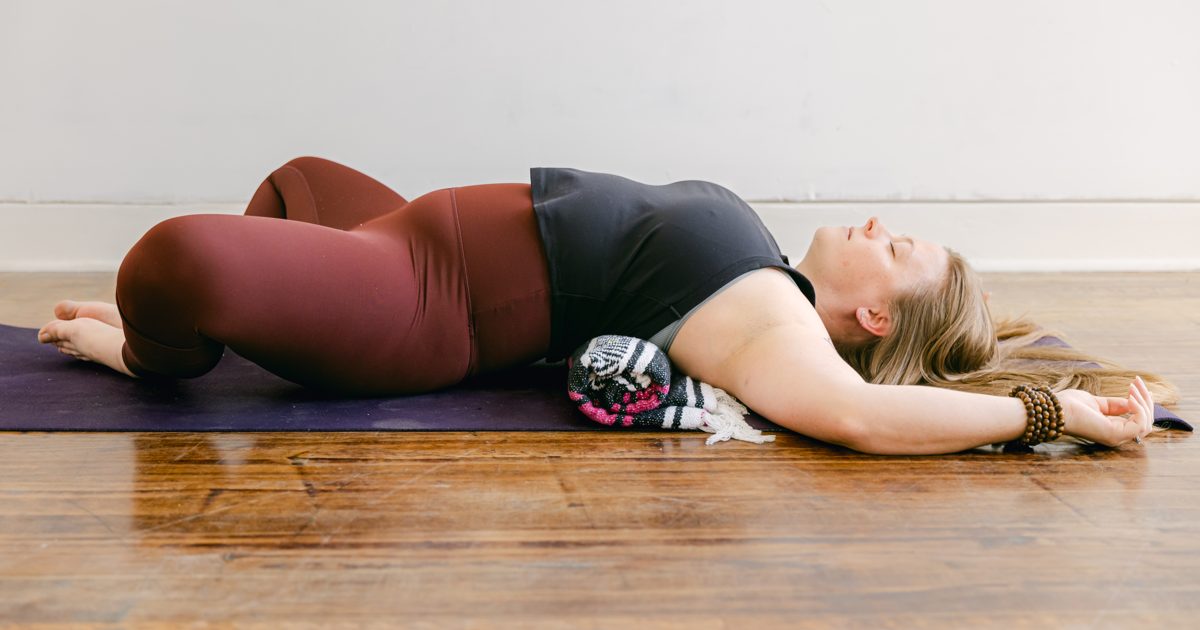
Windshield wiper knees. Cue: let them fall slowly. Feet wide, knees drop side to side. This is hip rotation, the exact movement your low back has been covering for. The mistake is rushing it and letting momentum swing the knees. Slow is where the hips actually learn.
Half happy baby and eagle twist. Cue: let the floor hold you. Hug one knee wide toward your armpit, then cross that leg over the other and let both knees fall into a twist. The mistake is gripping your shoulders off the mat to go further. Let both shoulder blades rest heavy, even if your knees don’t reach the floor. Use a pillow under them if you like.
Supported savasana or legs up the wall, plus a body scan. Cue: nothing to do. A bolster or blanket under your knees takes pressure off the low back. Or swing your legs up the wall. Then I walk you through a body scan. The mistake? Skipping it. This is the part that tells your nervous system the day is over.
When you’re done, try the self-test again. Most people notice the knees fall a little lower and the hips share more of the turning.
Why steady beats stiff
When something hurts, it’s natural to brace. We tighten the belly, lock the low back, hold our breath. It feels safer.
But bracing all day is exhausting, and a rigid back can’t make the tiny adjustments that keep you comfortable. Steady is different. Steady is a base that can move. It’s soft knees, a long exhale, and hips that take their share of the turning so your back doesn’t have to grip.
That’s why this class is so slow. You can’t rush your way into steady.
Make it stick off the mat
- Do the windshield wipers in bed. Ten slow drops side to side before you get up, or before you fall asleep.
- Sit on the floor during TV. Easy seat on a cushion, then switch the cross of your legs halfway through.
- Turn from your hips. Reaching into the back seat? Pivot your feet and hips first, instead of twisting from your back.
- Little and often. Two or three short sessions a week beat one big stretch session.
When to see a professional
If your back pain came with a fall or injury, travels down your leg with numbness or tingling, wakes you up at night, comes with fever or unexplained weight loss, or with any change in bladder or bowel control, see a doctor right away. And if your hip pain is deep in the groin or catches and clicks, get it checked before you work on it. Yoga is a great partner to care, not a replacement for it.
Let your hips take their share
Your low back has been working a double shift it never signed up for. This week, give it a break. Let the hips do some of the turning. Let the floor hold you. Find the kind of steady that doesn’t need to brace.
Now tell me: which part of the self-test surprised you most? Drop it in the comments on the video, or hit reply if you’re on my email list. I read every one.
Want an hour that leaves you steadier? Practice with me live on Thanksgiving eve at the Gratitude VinYin, Wednesday, Nov 25, 6pm CT: a warm vinyasa, then long, quiet yin holds. Donation-based, camera off is fine, and the replay is included. Feel Good Flow is back Wednesday, Dec 2. Save your spot.
Take the free 14-minute class